Abstract Algebra from scratch in Haskell
While learning Haskell is impossible not to notice the use of mathy objects like Monoids and Semigroups within GHC.Base. Then you get to learn that surprisingly, lists ([]) are Monoids! And then you start having curiosity about, what about really mathy objects, and how can they be represented via typeclasses and Haskell?
Well, that at least happened to me - and this post is going through the construction and definition of the cyclic group z2 and its way on algebraic structures up to being a well behaved Group. Let’s get started!
Because we want to user proper names but we don’t want to prefix things with My for god’s
so let’s make sure we’re can use our functions in qualified form:
module Lib whereWe start by defining the z2 cyclic group:
data Z2 =
    E |
    A deriving (Show)
Now, our binary operation and the encoding of its multiplication table will be done by the dot function.
This would be a bit tricky to construct from zero if a larger group were used. I thought about encoding
this without pattern matching every case but didn’t find a way. Will like to explore GAP more to see how they do it.
But anyways, this is our binary operation:
dot :: Z2 -> Z2 -> Z2
dot E A = A
dot A E = A
dot E E = E
dot A A = E
And we can see that it accurately reflects its multiplication table:
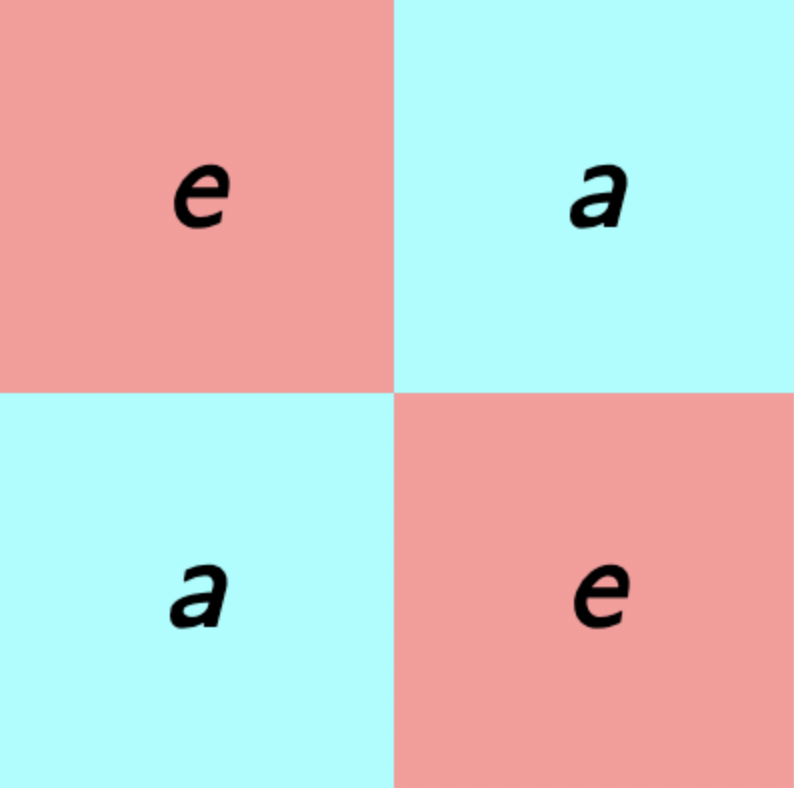
After that, we can now define a semigroup. We do not start with a magma because that will only mean a set and a binary operation (M, •) with closure. However, in order to define a Haskell typeclass we need some restriction in the constructor.
Now, as Haskell is right associative already, we only need to specify that the typeclass needs a function of two arguments (binary operation) that returns a value of the same type (closure).
class Semigroup a where
    (<>) :: a -> (a -> a)
We can now finally instantiate our Semigroup class with Z2 and specifying the binary associative operation! In this case will be dot, which we previously defined to encode our times table.
instance Lib.Semigroup Z2 where
    (<>) = dot
If we do a quick test, we can see that our function is indeed associative:
main = do
    putStrLn $ "Semigroup (assosiacivity) - (A <> A) <> E = " ++ show
        ((A Lib.<> A) Lib.<> E)
    putStrLn $ "Semigroup (assosiacivity) - A <> (A <> E) = " ++ show
        (A Lib.<> (A Lib.<> E))
This will output:
Semigroup (assosiacivity) - (A <> A) <> E = E
Semigroup (assosiacivity) - A <> (A <> E) = E
Nice, we’re associative :)
Okay, let’s do something more fun now. We now that adding an identity element to a Semigroup
will mean having a Monoid. Let’s leverage Haskell’s typeclasses power and inherit Semigroup
with its associative operation, and add an identity element.
class Lib.Semigroup a => Monoid a where
    mempty :: a
Pretty, cool. Let’s now instantiate z2 with it.
-- E is our identity element, so this is straight forward
instance Lib.Monoid Z2 where
    mempty = E
A quick sanity check:
main = do
    putStrLn $ "Monoid (+identity element) - A <> E) = " ++ show
        (A Lib.<> Lib.mempty)
    putStrLn $ "Monoid (+identity element) - E <> E) = " ++ show
        (E Lib.<> Lib.mempty)
And output:
Monoid (semigroup w identity element) - A <> E) = A
Monoid (semigroup w identity element) - E <> E) = E
Great, Monoids are cool. Let’s finally move to Groups now!
We follow the same approach and inherit, instantiate and print some of our properties.
For this one we will need to add an invert function to Monoid so we have invertibility.
This will be defined by having an invert function such that:
a <> invert a == mempty
invert a <> a == mempty
Let’s define it!
class Lib.Monoid a => Group a where
    invert :: a -> a

-- because the only way to get mempty in z2 is by
-- doting and element by itself
-- our invert function is dot by the identity element
instance Lib.Group Z2 where
    invert = dot Lib.mempty

-- print print
main = do
    putStrLn $ "Group (monoid + inverse) - invert A <> A) = " ++ show
        (invert A Lib.<> A)
    putStrLn $ "Group (monoid + inverse) - A <> invert A) = " ++ show
        (A Lib.<> invert A)
    putStrLn $ "Group (monoid + inverse) - invert E <> E) = " ++ show
        (invert E Lib.<> E)
    putStrLn $ "Group (monoid + inverse) - E <> invert E) = " ++ show
        (E Lib.<> invert E)
Output:
Group (monoid + inverse) - invert A <> A) = E
Group (monoid + inverse) - A <> invert A) = E
Group (monoid + inverse) - invert E <> E) = E
Group (monoid + inverse) - E <> invert E) = E
Great no? We have first created our own small ADT for z_2. Then, defined Semigroup, Monoid and Group
typeclasses and instantiated our z_2 ADT to make use of the methods within this typeclasses so we make it both
explicitly and fun to experiment with our small little cyclic group.k